Case Study #2
Intercompany Billing Engine — Automated financial system for cross-entity reconciliation
Project Overview — Intercompany Billing Engine
Role — Lead Product Designer.
Responsibilities — Discovery · Workflow Design · System Modeling · Information Architecture · Interaction Design.
Collaboration — Finance Teams · Product Owner · Engineering.
Key Constraint — No direct ERP workflow; manual reconciliation had to be replaced without disrupting month-end operations.
Context — The organization managed millions in cross-entity charges using fragmented spreadsheets, resulting in high dispute rates, manual audits, and delayed month-end closing.
Opportunity — Design a centralized system to automate governance, improve data integrity, and enable real-time financial visibility.
Product Evolution — Following the initial launch, I continued to support the product through subsequent iterations and the introduction of new capabilities, ensuring that the underlying interaction patterns and workflows evolved consistently as business needs changed.
01. Operational Challenge
Financial teams relied on disconnected tools and manual processes to manage intercompany billing.
This created a system that was:
Slow to audit
Prone to human error
Difficult to scale
As transaction volume grew, the lack of centralized governance made it increasingly hard to ensure accuracy, traceability, and timely resolution of disputes.
02. Greenfield Challenge: From Fragmentation to Control
The system relied on a fragmented workflow where data was captured in decentralized spreadsheets before being manually re-entered into SAP.
This “double-handling” introduced significant risks to data integrity and made it difficult to maintain a reliable audit trail.
The challenge was to replace this manual bridge with a governed system that validates data at the source and syncs directly with the ERP.
This wasn’t just a tooling issue—it was a breakdown in governance and system trust.
03. My Role
I approached the problem as a systems design challenge—focusing on reducing manual effort while enforcing consistency and traceability across financial workflows.
The solution centered on three principles:
Automation over manual intervention
Reduce reliance on spreadsheets and human input.
Centralized governance
Establish a single source of truth for all transactions.
Contextual workflows
Surface relevant data and actions based on the billing lifecycle.
04. System Architecture & Workflow
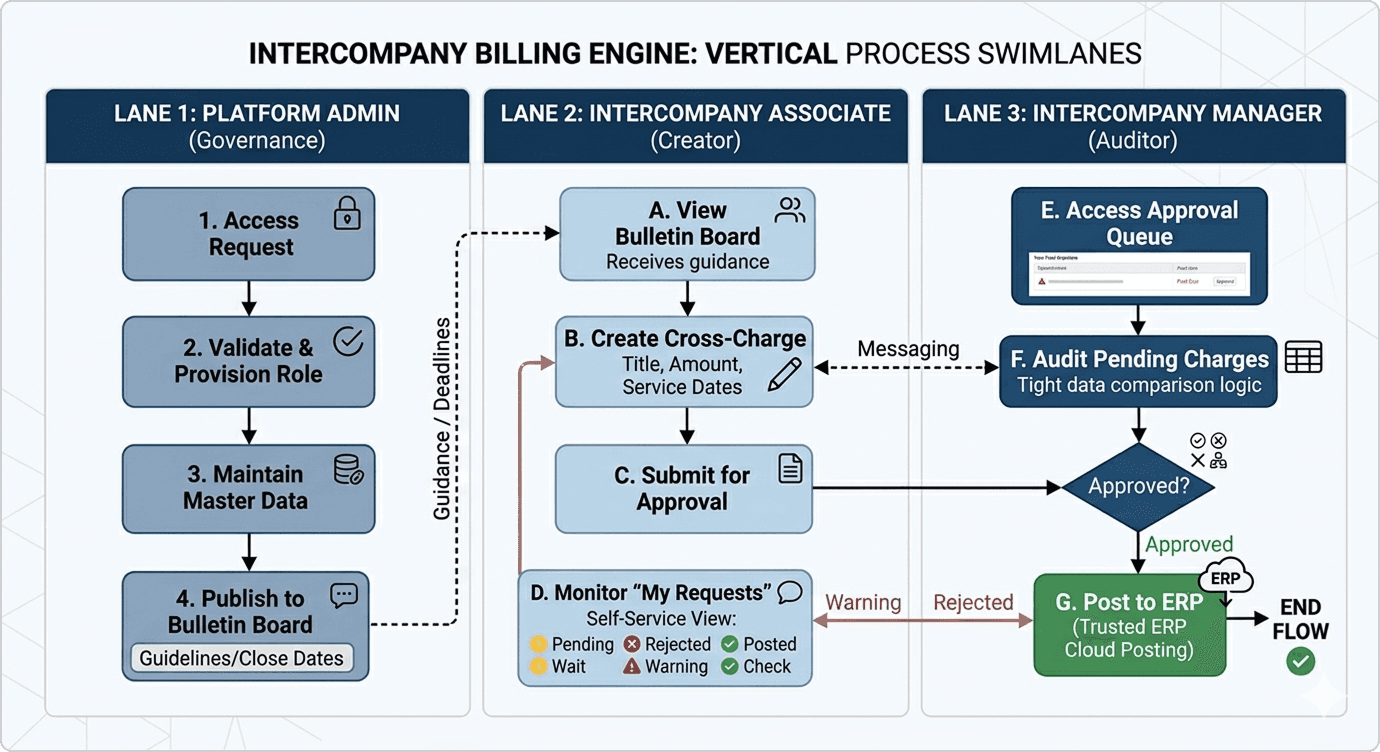
To replace fragmented workflows with a governed system, I designed a structured process model that defines how roles, data, and approvals interact across the billing lifecycle.
Key System Decisions
Validation at the Source — Business rules are applied during data entry, preventing errors before they propagate downstream.
Contextual Collaboration — Disputes are handled within the workflow itself, replacing fragmented email threads with structured, traceable communication.
This structure transforms billing from a linear, manual process into a governed system with clear ownership, traceability, and control at every stage.
05. Command Center: Information Architecture
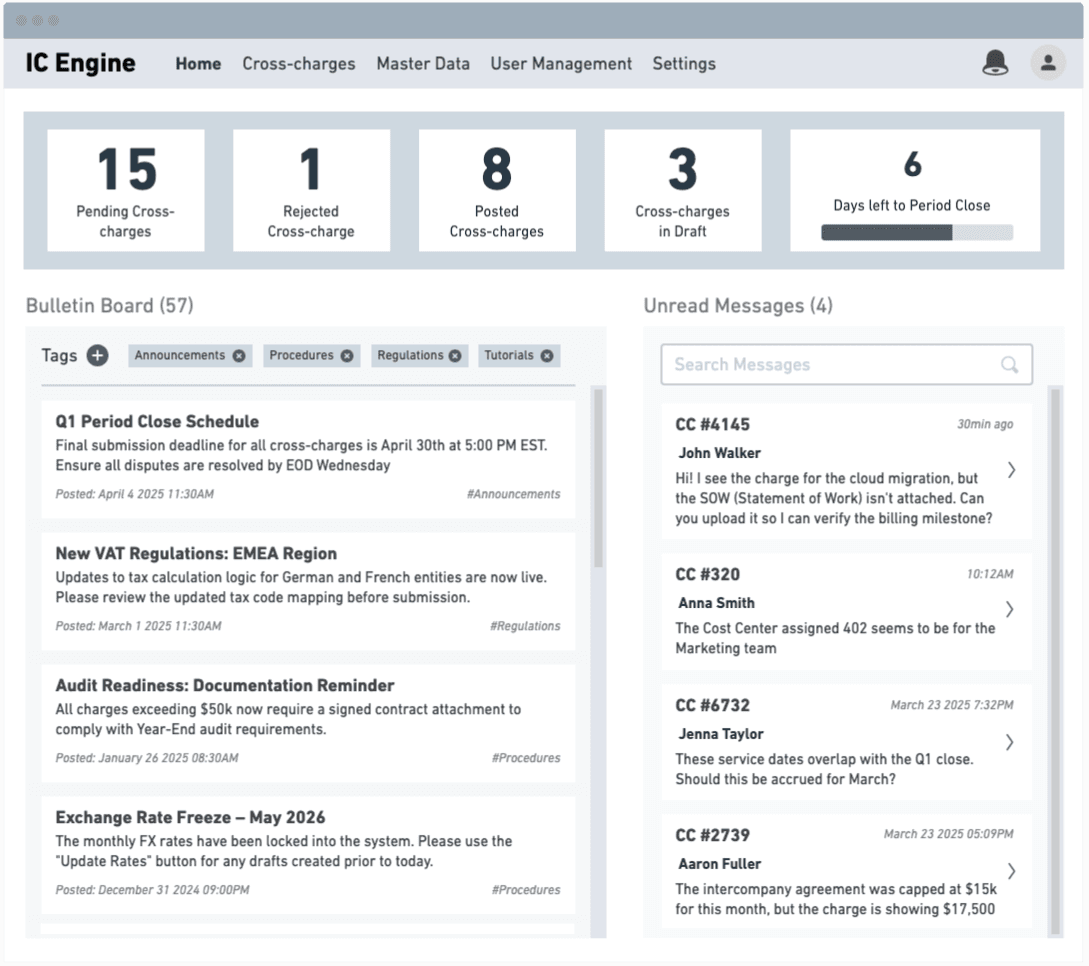
I designed the command center as a high-density operational view that surfaces urgency, blockers, and system-wide communication in a single place.
Driving Urgency
A “Days to Period Close” countdown anchors the interface around the most critical deadline, ensuring time-sensitive actions remain the primary focus.
Surfacing Blockers
Unread messages are elevated to the main view, allowing users to quickly identify and resolve issues that would otherwise delay charge approvals.
Embedding Governance
The Bulletin Board serves as a centralized channel for policies, tax updates, and procedural changes—integrating governance directly into daily workflows.
This structure shifts the dashboard from a passive reporting tool into an active decision-making surface.
06. Audit Queue: High-Density Interface Design
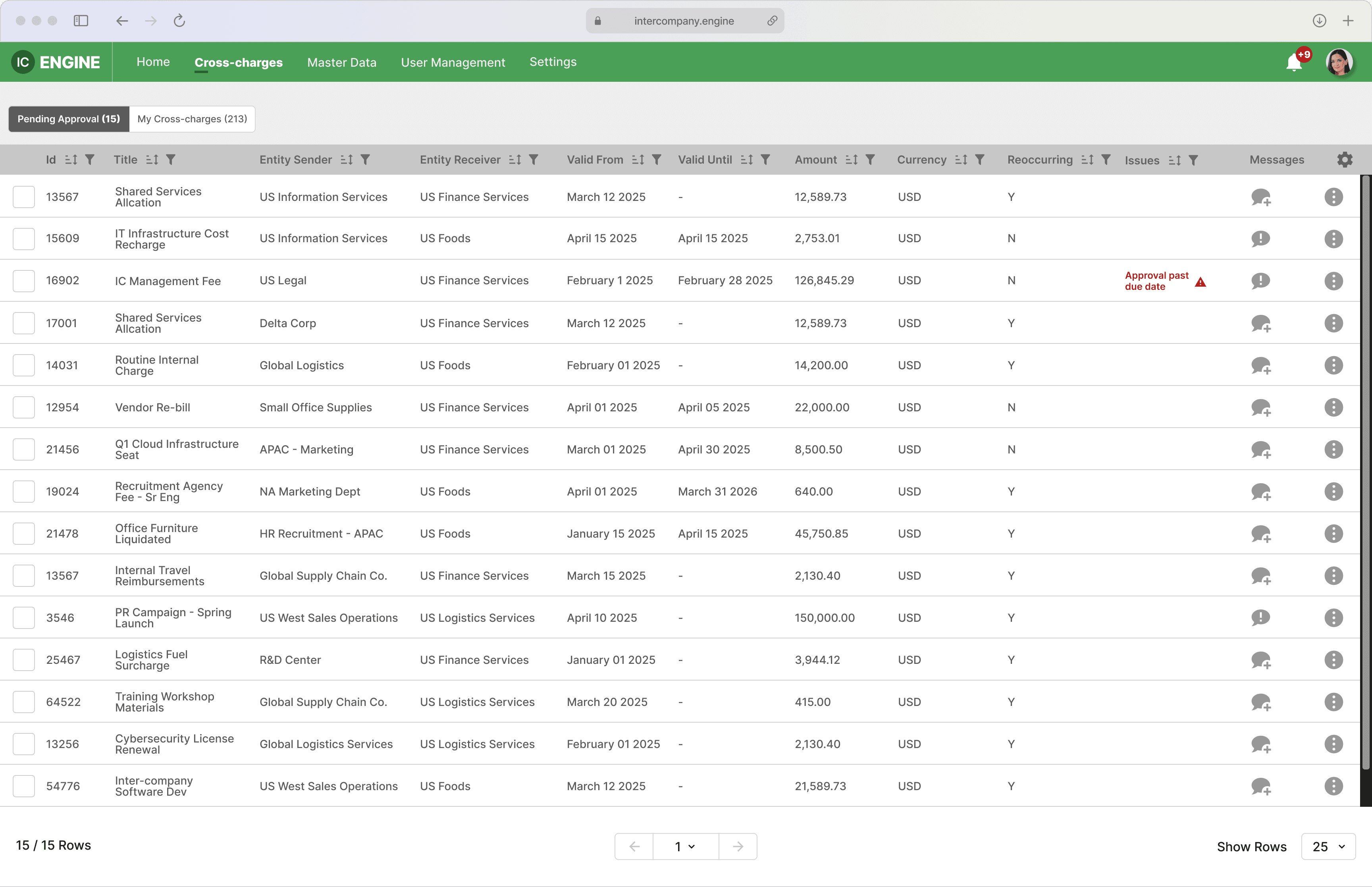
The audit queue is where financial managers validate and approve charges under time pressure, requiring dense information without sacrificing clarity.
Designing for High-Density Auditing
Financial managers must review large volumes of transactional data quickly and accurately.
I optimized vertical rhythm and column hierarchy to support 20+ data points per row while maintaining scannability—ensuring all information required for SAP validation is visible at a glance.
This enables rapid comparison across entries without requiring users to drill into individual records.
07. Accelerated Workflows: Bulk Actions & Validation
To support rapid decision-making at scale, the audit queue enables bulk actions across large volumes of financial data.
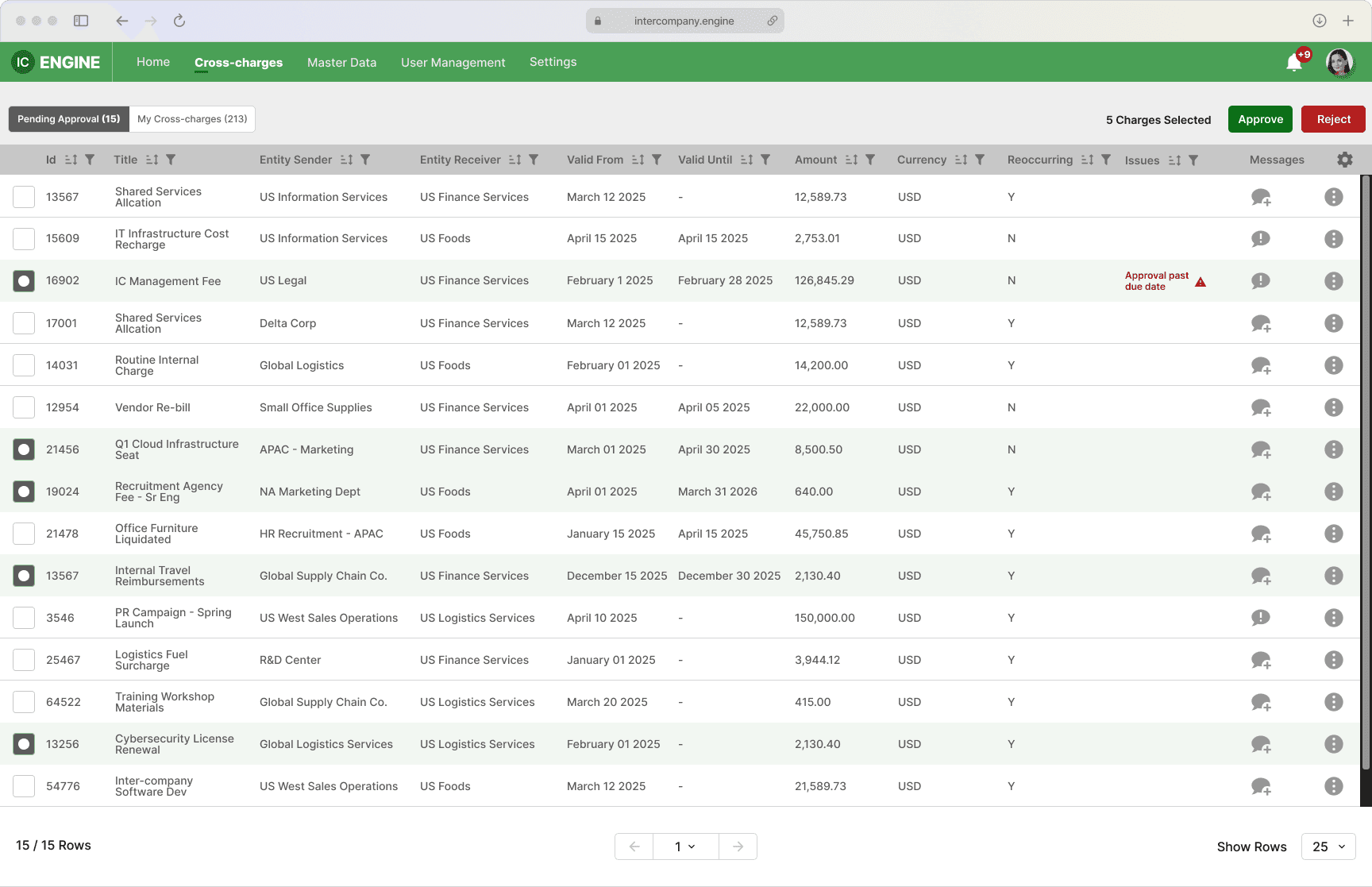
In high-volume financial environments, processing charges one-by-one creates a bottleneck. I designed a bulk selection model that allows managers to validate and approve hundreds of line items simultaneously.
Real-time feedback indicates which items are “Ready to Post” versus “Require Info,” reducing batch approval errors and increasing confidence at scale.
This shifts the audit process from sequential review to parallel decision-making.
08. Business Impact
This shift from fragmented workflows to a centralized system delivered measurable impact across key financial operations—driven by automating validation at the source, reducing manual handoffs, and surfacing real-time visibility across the workflow.
Performance Indicator | Legacy Process | IC Engine (Solution) |
|---|---|---|
| Audit Speed | 30-60 mins per charge | < 3 mins per charge |
| Dispute Resolution | Email-based, fragmented | Centralized Contextual Communication |
| Data Integrity | Manual ERP Re-entry (High Risk) | Automated ERP Sync (Zero Risk) |
| Submission Accuracy | Reliant on tribal knowledge | Rule-based validation |
| Month-End Visibility | Blind until close | Real-time Dashboard |
The system doesn’t just improve efficiency—it shifts financial operations from reactive reconciliation to proactive, real-time control.
09. Designing for Complexity at Scale
Building this system from the ground up reshaped how I think about enterprise design—beyond interfaces, toward systems that scale with complexity.
Logic Before Pixels
In enterprise systems, solving the underlying data flow (“plumbing”) is the foundation of good design.
Density as a Tool
For expert users, clarity comes from well-structured information, not from reducing data at the cost of context.
Translating Complexity
Effective systems translate domain-specific logic into intuitive patterns that feel familiar while improving reliability.
Ultimately, this project reinforced that great enterprise design isn’t about exposing complexity—it’s about absorbing it, so users can act quickly without needing to understand the system behind it.