Project Overview: Evolution from Spreadsheet to Sales Kit
Role — Lead Product Designer.
Responsibilities — Product Strategy · Workflow Design · Mobile UX · Interaction Design.
Collaboration — Sales Teams · Business Stakeholders · Engineering.
Key Constraint — Offline-first operation with no live backend integration.
Objective — Transforming a manual, Excel-based excursion and transfer sales process into a professional mobile toolkit designed for fast-paced, in-person sales.
Outcome — A high-velocity interface for real-time, side-by-side client consultation, reducing redundant data entry by 80%.
01. The Context
The Problem:
Sales for excursions and transfers were managed through a shared Excel spreadsheet, requiring manual entry for every transaction.
Without integration with upstream systems, data entry was redundant, error-prone, and slowed down the sales process—creating a “clerical” experience instead of a consultative one.
The Objective:
Designed a mobile-first sales toolkit that transforms agents from data entry operators into confident consultants.
The system prioritizes speed and simplicity—streamlining the sales flow to maximize transactions per interaction while minimizing customer waiting time.
Design Constraints
Unreliable Connectivity
The interface was designed to support uninterrupted selling, allowing agents to continue transactions offline and sync data once a stable connection is available.
No System Integration
With no backend validation, the interface guides accurate data entry in real time—reducing errors at the source and eliminating the need for downstream correction.
Agents operate in high-traffic environments (e.g., hotel lobbies and airports), where speed directly impacts revenue and customer experience.
02. Strategic Pivot
From "Data Entry" to "Consultative Selling"
The shift from spreadsheets to a dedicated sales toolkit wasn’t just a tooling upgrade—it redefined the interaction between agent and customer.
Legacy Friction (The Excel Era)
Redundant Data Entry
Re-entering customer details for every transaction.
No Validation
No real-time checks for availability or conflicts.
Opaque Experience
A spreadsheet-driven workflow that excluded the customer and reduced the agent to a data operator.
The Design Shift
Instead of navigating rows and fields, agents guide customers through a visual catalog designed for real-time selection.
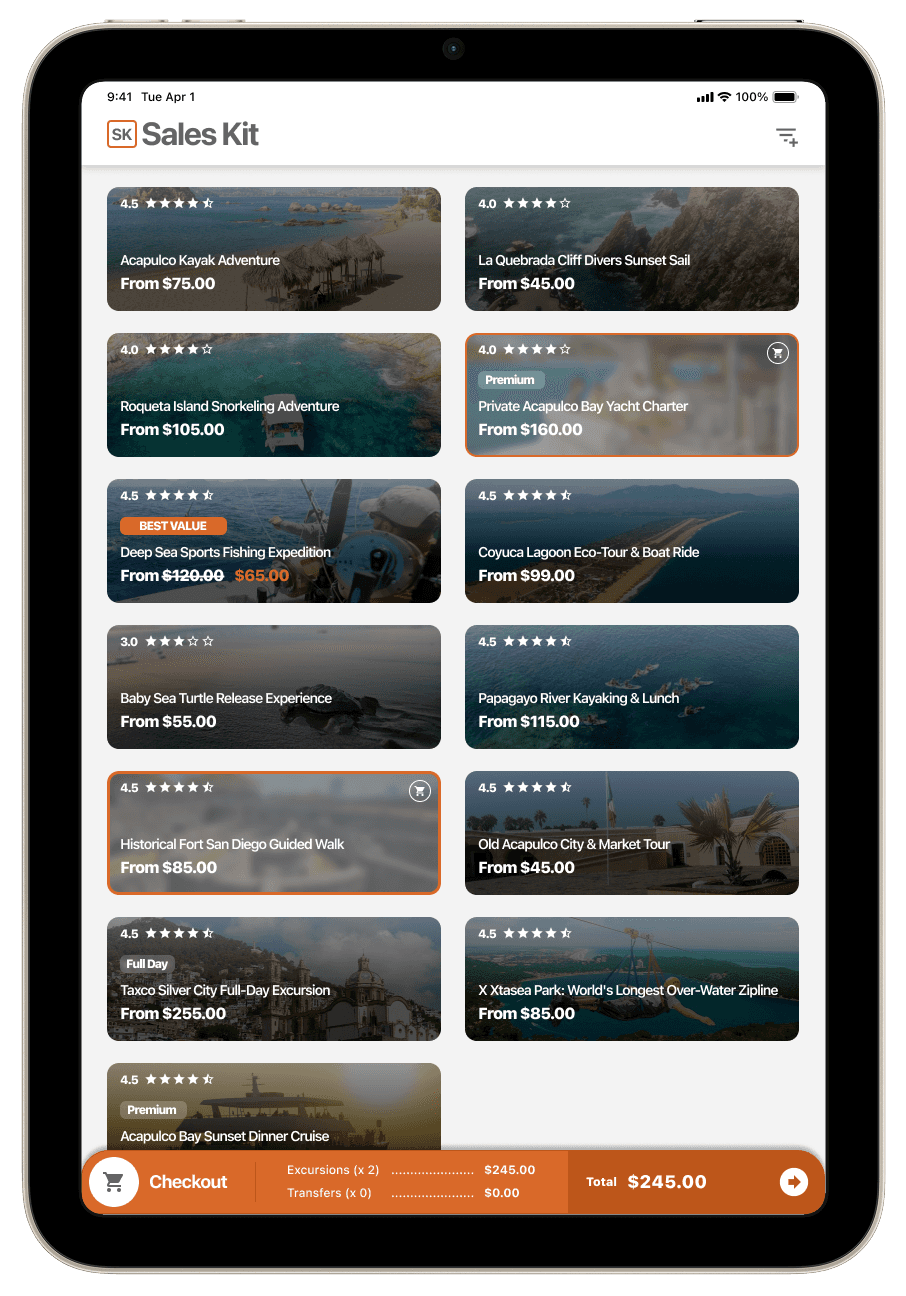
By introducing a visual-first catalog, the experience shifts from data entry to guided discovery.
Customers stay engaged with the “why” (the experience), while agents manage the “how” (logistics) in a shared, real-time interface.
Previously, each transaction required full data re-entry. The new system reduces this to a single capture per session, shifting effort from repetition to selling.
03. Solving the Data Constraint
Designing the Booking Logic
The core challenge wasn’t visual—it was structural. Without live system integration, the interface had to handle data capture, session persistence, and validation entirely within the UI.
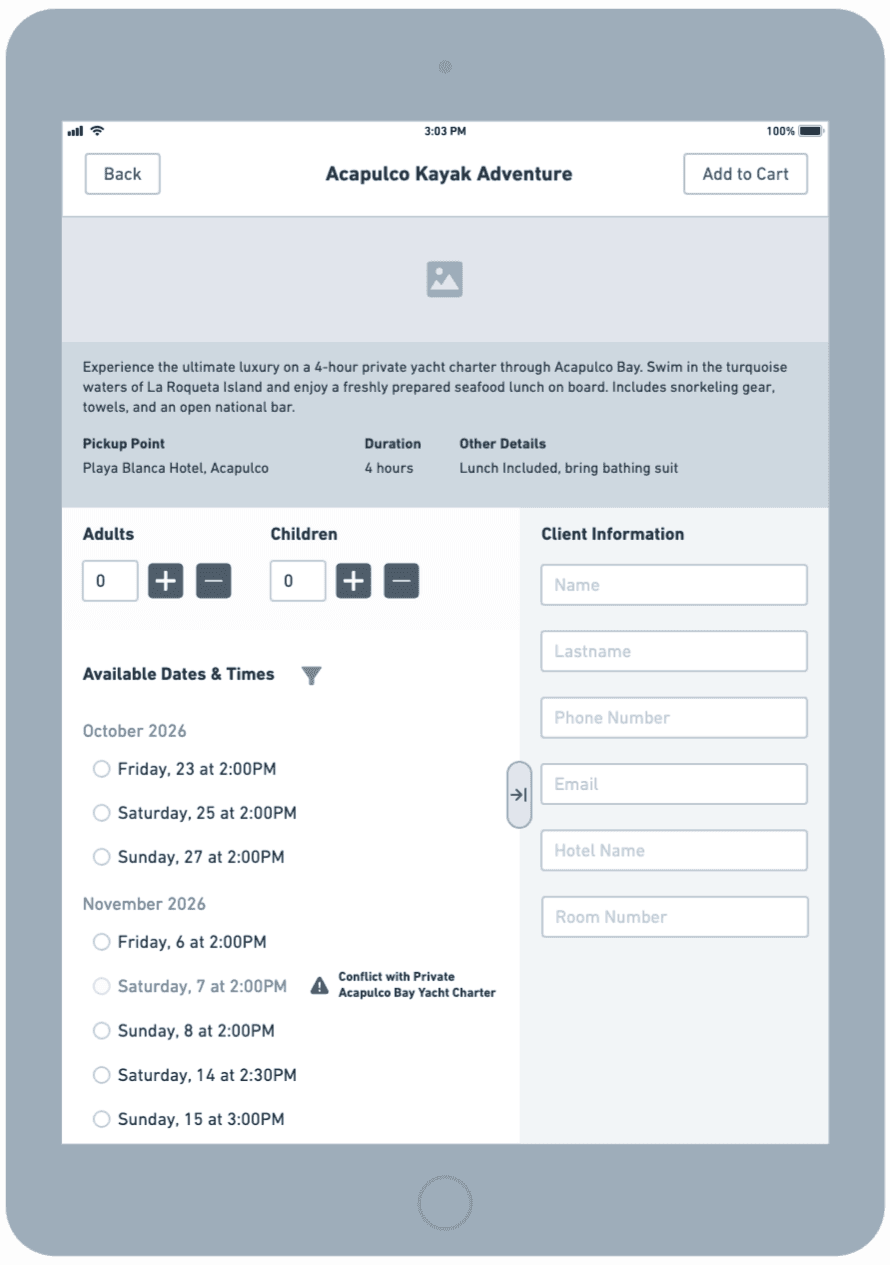
To focus on these interaction patterns, I developed the booking flow using high-contrast wireframes. This allowed me to isolate and refine the information architecture, session states, and error-handling logic before introducing visual styling.
Designing for Session Persistence
Without a live system connection, the interface had to manage data capture and reuse within a single session. The key challenge was reducing repetitive input while keeping the interaction fast and fluid.
To solve this, I designed a two-state interaction model that adapts based on user progress.
Interaction Model
State A: Initial Intake
The first interaction focuses on fast identification. A simplified form with large tap targets and clear structure enables the agent to quickly capture client details in a shared, side-by-side interaction.
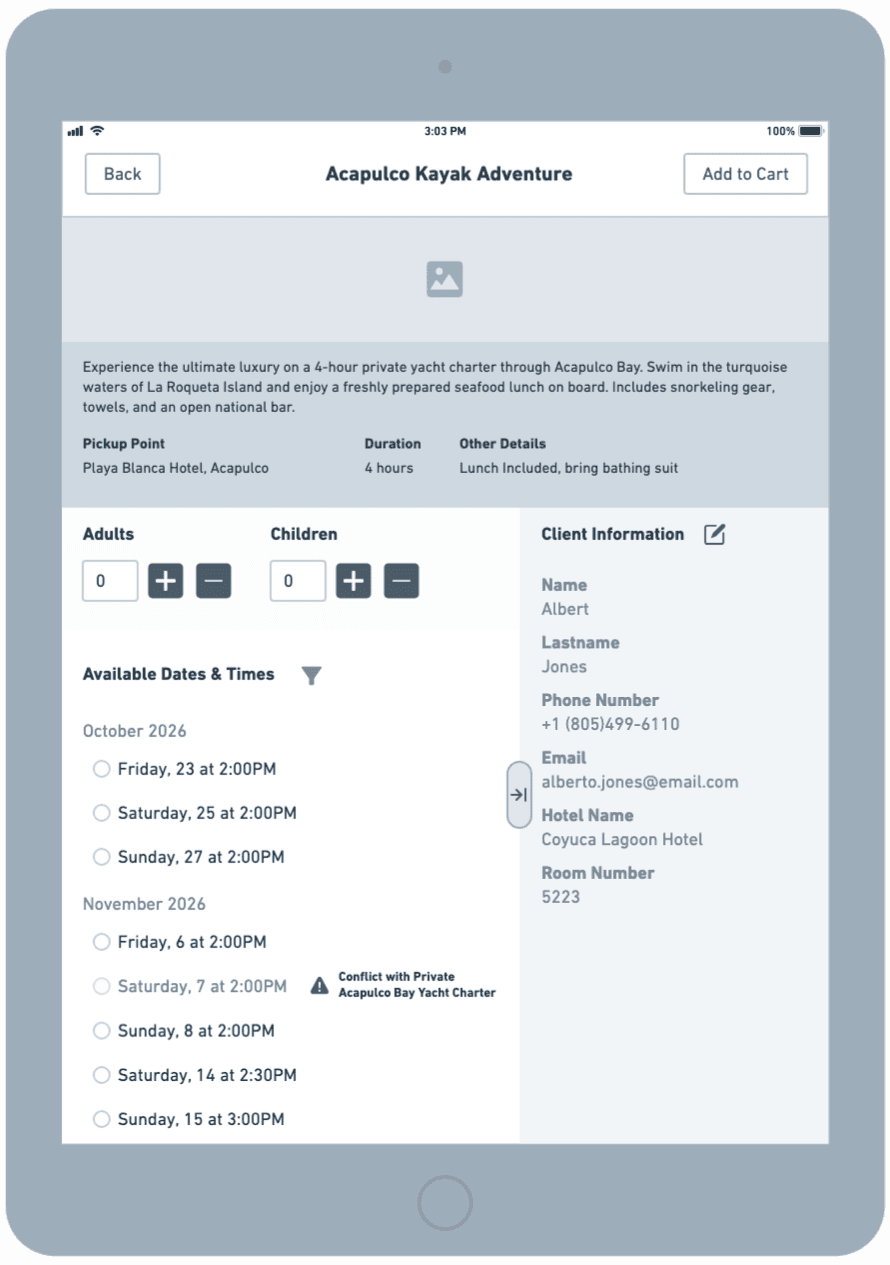
State B: Persistent Summary
Once captured, client data becomes persistent across the session. For subsequent purchases, the form collapses into a read-only summary, allowing the agent to skip repetitive input and move directly to scheduling.
Contextual Validation
The interface proactively checks for scheduling conflicts based on existing selections. By surfacing issues (e.g. overlapping bookings) directly within the flow, errors are prevented at the point of sale.
Impact
This model reduced redundant data entry by 80% in multi-item sessions, enabling faster transactions and minimizing friction during peak sales moments.
Maintaining Flexibility at Speed
A persistent “Edit” action allows agents to update client details at any point, ensuring they’re never locked into previous inputs while keeping the interaction fast and uninterrupted.
04. Measuring Success: The Operational Gains
Business Impact
Faster Transactions
Automating client data persistence reduced booking time by 60–70% in multi-item sessions, allowing agents to serve more clients during peak hours.
Eliminated Manual Re-entry
Data flows directly from the tablet into structured formats, removing the need for duplicate entry and significantly reducing human error.
Revenue Protection
Real-time scheduling validation prevents double bookings at the point of sale, reducing refunds and preserving both revenue and customer trust.
These improvements transformed the sales flow from a manual process into a fast, reliable, and scalable system.